
If you had asked the version of me from 20 years ago — the corporate tax attorney explaining IRS intricacies to rooms full of accountants — whether I’d one day be speaking on stages about artificial intelligence, I would have laughed. Back then, high tech meant a Blackberry. AI was The Jetsons.
Fast forward through what I call a “plural” career — from tax law to traveling the world as an influencer and consultant for tourism boards across Europe and Asia — and here I am. In the third quarter of my life, completely obsessed with AI.
Not because it’s trendy. Because the genie is out of the bottle, and most businesses haven’t noticed yet.
I Am Your Target Demographic — And You Can’t Reach Me
I have disposable income. I make buying decisions every day. And I use ChatGPT, Gemini, Claude, and Perplexity constantly — to decide where I eat, what I buy, and how I travel.
I am not a tech-savvy 20-something. I’m a woman in her 50s who treats AI tools the way a previous generation treated Google. If I am this embedded in AI-driven search, your target audience is too — or they will be very soon.
And here’s the problem: most businesses are completely invisible to the tools their customers are using to find them.
How People Are Actually Searching Today
There is a widening gap between how companies spend their marketing budgets and how consumers actually find information right now. That gap is growing every month.
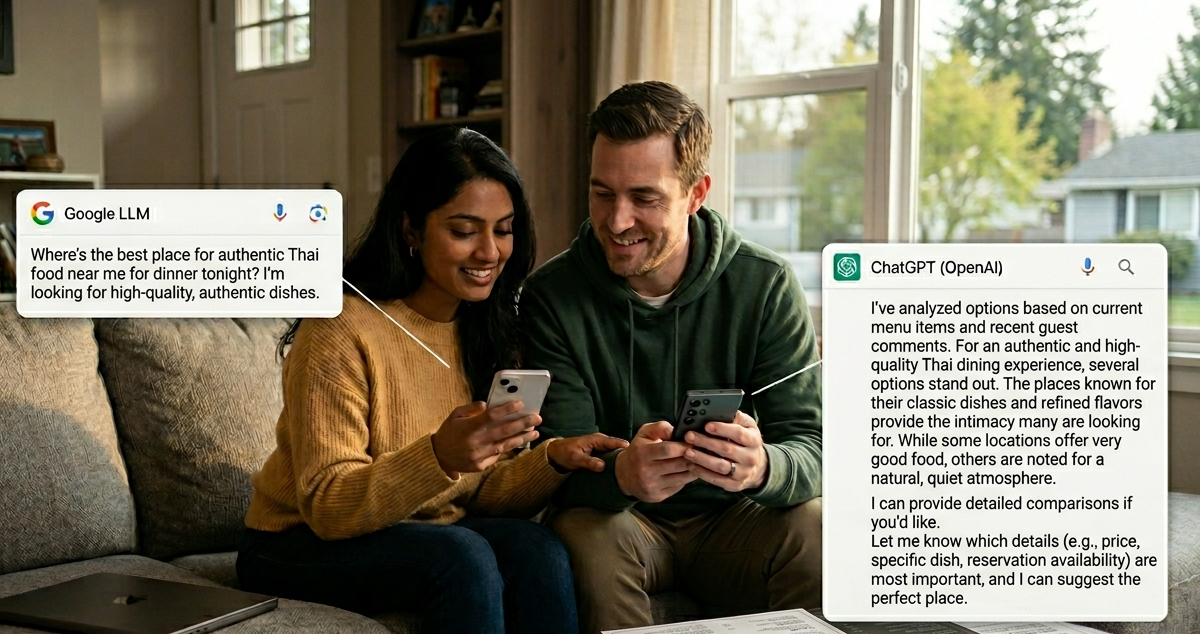
Think about how you searched for something five years ago. You opened Google, typed a few keywords, and clicked a link. That behavior is shifting — fast — toward a conversational model. People aren’t just searching anymore. They’re consulting.
I see this every day in my own life. I’ve been trying to find a local med spa that offers cryotherapy. My favorite spot, Fire and Ice, is excellent — but it’s a 30-minute drive. I’d love to go four or five times a week. The distance makes that impossible.
When I turn to an AI tool to find a closer alternative, I hit a wall. I either can’t find what I need, or the tool points me to one or two businesses that aren’t the best or the closest — they’re just the only ones that made their information visible to AI. The better options, the ones that might actually serve me well, are invisible.
If your business isn’t showing up in those conversations, you’re not ranking low. You don’t exist.
The Seismic Shift in How Consumers Shop
Here’s a concrete example of how my behavior has changed.
Suppose I’m planning a two-week trip to France in the spring and I need shoes. Two years ago, I would have gone to Amazon and typed “travel sandals” or searched Google for “best travel shoes for Europe” and read a few blog posts.
Today, my process looks like this: I open Gemini and explain my situation in full. I’m going to France for two weeks in the spring. I need something that isn’t a summer sandal but isn’t a heavy winter boot. It has to be comfortable enough for all-day walking on cobblestones but presentable enough for dinner in the evening. What do you recommend?
We have a back-and-forth conversation. I narrow it down. Eventually, Gemini gives me a specific list of brands and products that fit my exact context — with links.
This is not a refinement of the old way of searching. It’s a replacement. I’m not looking for a keyword match. I’m looking for a recommendation based on my specific situation.
The shift from typing “travel sandals” into Amazon to having a full contextual conversation with an AI tool is as significant as the shift from asking a friend for a recommendation to looking something up online. It changes everything about how businesses need to show up.
Why Most Businesses Are Invisible to AI
Many businesses — especially larger ones — are simply not moving fast enough. They’re still investing in traditional SEO and marketing strategies built for a 2019 world, while their customers have moved on.
If a shoe brand hasn’t structured its website, social channels, and reviews to answer specific, contextual questions — the kind a consumer is actually asking an AI — it will never appear in that conversation. It doesn’t matter how good the product is.
The winners in this new landscape won’t necessarily be the best businesses. They’ll be the most visible ones.
I may never find the most comfortable travel shoe for France, because the brand that makes it is still operating on the old playbook. They’ve become invisible not because their product failed, but because their marketing didn’t evolve.
In our own marketing agency, we shifted how we create content for clients significantly between January and April of this year alone. That’s how quickly this is moving.
What This Means for Your Business
If you’re a business owner, the question to ask right now is simple: can an AI find the information my customers are looking for — and recommend me confidently?
We are moving away from keyword density and toward contextual authority. AI tools don’t just pull the first result for a search term. They synthesize information from your website, your Google Business profile, your social channels, your reviews, and increasingly from video platforms. If you aren’t providing the depth and specificity that LLMs need to recommend you, you’re handing market share to whoever moves faster.
The future of marketing isn’t about being the loudest in the room. It’s about being the most useful in the conversation.
The Bottom Line
The way consumers find businesses has changed — not gradually, but decisively. The conversational AI tools people are using every day are replacing the keyword searches that traditional marketing was built around. Businesses that adapt their content strategy to meet that shift will be recommended. Businesses that don’t will be invisible.
The genie is out of the bottle. The question is whether your business is visible to it.
Key Takeaways
- Consumer search behavior has fundamentally shifted from keyword-based to conversational. AI tools are now where buying decisions begin.
- Being invisible to AI isn’t about ranking low — it’s about not appearing at all. There is no page two in a conversational AI response.
- The businesses winning AI visibility aren’t always the best. They’re the ones that have made their information clear, specific, and accessible across multiple channels.
- Traditional SEO is not enough. AI search requires contextual authority — content that answers the specific scenarios customers are actually describing.
- This is moving fast. Strategies that worked in early 2024 are already being updated. Waiting is not a neutral choice.
FAQ
AI tools pull from your website, Google Business profile, social channels, and third-party sources. If your services aren’t described in clear, specific, crawlable text that addresses the actual questions consumers ask, the AI can’t confirm you’re relevant — and won’t include you in its response.
Traditional SEO was built around matching keywords. AI search is built around answering questions. An AI tool doesn’t return a list of links — it synthesizes information and makes a recommendation. To appear in that recommendation, your content needs to address specific use cases and scenarios, not just contain the right terms.
A much broader demographic than most businesses assume. I’m a woman in my 50s with disposable income, and I use AI tools throughout the day for consumer decisions. The segment of the population doing this is growing across every age group and income level.
Start by auditing what AI tools actually know about your business. Ask Gemini, ChatGPT, or Perplexity specific questions as if you were a new customer. The gaps in what it can answer are exactly where your content needs work. Then prioritize your Google Business profile, website service descriptions, and social content — making sure each one is specific, current, and written in natural language.
Not necessarily all at once. But you do need to evolve it. The core shift is from writing content for search engine crawlers to writing content that answers the real, contextual questions your customers are asking. Start with your most important services or products and work outward.